

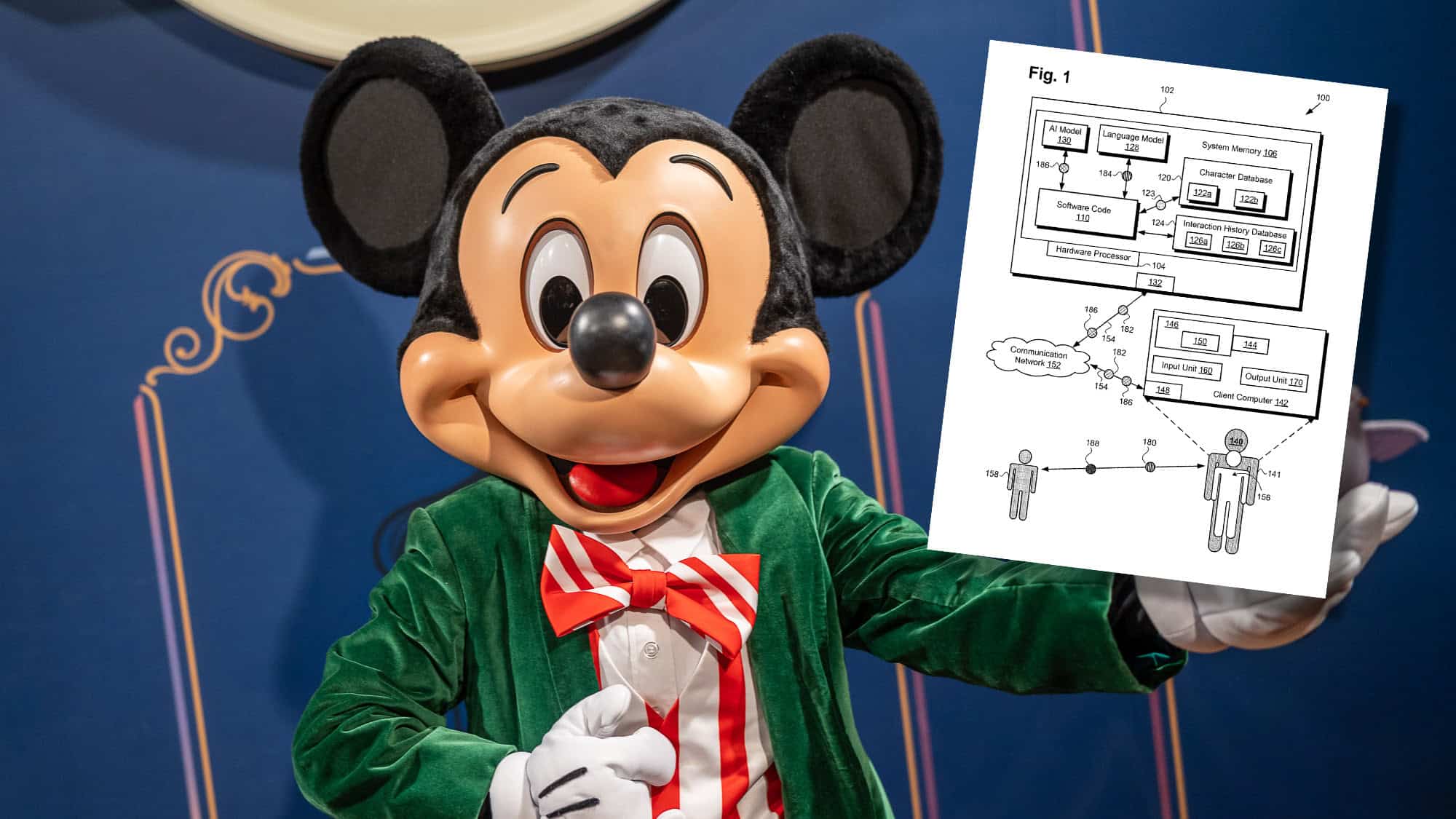
Disney received a patent today for an artificial intelligence system that would let costumed characters hold real-time conversations with guests in the character’s own voice. The system pairs a large language model with a voice-generating AI model. It also takes its emotional cues from an unexpected place: the face of the performer inside the costume.
Disney AI Patent Could Let Costumed Characters Talk With Guests
IN THIS ARTICLE:
- The patent describes an AI system that writes and voices replies for performers in character costumes.
- A performer’s facial expression would set the emotional tone of each line the character speaks.
Character meet-and-greets can be some of the most personal moments of a Disney vacation, and this patent zeroes in on them. The U.S. Patent and Trademark Office granted Disney the patent on November 3rd, 2026, about two and a half years after Disney filed it in May 2024. This one follows another recent AI-themed filing from Disney, an AI camera system that could send animal spotting alerts to guests on safari.
The patent starts with a challenge anyone who has met a costumed character already knows. Performers portraying famous characters with distinctive voices often can’t speak in their own voices, so they communicate through poses, gestures, and physical comedy. Disney’s filing states that pre-recorded lines can help, but guests would typically see those interactions as “lacking spontaneity and immersiveness.” The proposed fix is a system that writes and voices a fresh reply to whatever a guest actually says.
For families, the appeal is easy to picture. A character could answer a child’s question directly, in a voice that child already knows from the movies. That fits a broader push Disney has described for building AI into Imagineering and the parks.
How the System Builds a Character’s Reply
The process starts with listening. Microphones capture what a guest says. Separate modules then convert that speech to text and detect its prosody, which the patent defines as the stress, rhythm, and intonation of spoken language. An inward-facing camera inside the costume or mask watches the performer’s face at the same moment. Beyond the conversation itself, the system can take in background sounds, the time of day, the weather, and scheduled events happening nearby.
Next, the system pulls the character’s profile from a database. Disney’s paperwork lists several communication traits that profile could hold:
- A character archetype, such as a hero, villain, or sidekick
- The character’s persona, like optimism, confidence, or assertiveness
- The character’s typical prosody
- A distinctive vocabulary and favorite expressions
A large language model then combines the guest’s words with those traits to write a reply that sounds like that specific character. Disney’s filing says the model could be trained on the individual character, and it defines real-time as a reply arriving without an unnatural delay. An optional interaction history would let a character build on earlier conversations with the same guest. According to the patent, that history would preferably leave out any personally identifiable information.
A Performer’s Smile Sets the Tone
Once the reply is written, a generative AI model turns it into audio in the character’s voice. This is where the performer comes back in. Disney’s patent uses the performer’s facial expression to choose the emotional tone of the spoken line:
- A smile would produce a happy delivery
- A smirk would produce a smug one
- A frown would signal disappointment
The finished audio plays through speakers built into the costume or mask. Disney’s filing also describes optional mechanical actuators that could move the costume’s face to produce expressions. Each step could happen automatically, though the patent leaves room for a human editor to review responses.
Disney’s patent doesn’t name a character, a park, or an attraction. Its definition of a character is broad, covering cartoon characters, video game avatars, fictional people from film and television, and even historical figures. A patent also doesn’t confirm that Disney will build the system. Talking characters do have history at Walt Disney World, with Magic Kingdom’s Town Square Theater offering a talking Mickey Mouse meet-and-greet for several years in the 2010s. Currently, characters such as Stormtroopers and Kylo Ren speak with guests using pre-recorded lines in Star Wars: Galaxy’s Edge.
The patent arrives during a busy stretch for Disney and AI. Disney named former Character.AI CEO Karandeep Anand its first Chief Technology Officer in September. This patent traces back to the May 2024 filing, well before the move, but consistent with overall goals stated by current Disney CEO Josh D’Amaro.
Keep Reading
- Disney’s earlier filing describes an AI camera system for animal spotting alerts that could ping guests when a favorite animal appears.
- Disney named a former Character.AI leader its first CTO, then stepped in as the leading bidder for Character.AI’s assets after the company’s bankruptcy filing.
- Josh D’Amaro laid out how AI is reshaping Imagineering and park operations, from attraction design tools to vacation planning.

As always, keep checking back with us here at BlogMickey.com as we continue to bring you the latest news, photos, and info from around the Disney Parks!